

Course: Small-Scale Hotel Infrastructure Projects in Armenia
Practical guide to launching and managing small-scale hotel infrastructure formats in Armenia — from site assessment to attracting investments.
Small accommodation formats — campsites, glamping, eco-lodges — are becoming a distinct category of development and investment projects. They are cheaper to launch, reach the market faster, and allow flexible work with land, logistics, and seasonality. However, they require particular precision — legal, design, and financial.
Welcome to the practice-oriented course on launching and managing small-scale hotel infrastructure formats in Armenia
Against the backdrop of growing domestic tourism, international interest in sustainable development, and the emergence of private and grant initiatives, Armenia is becoming one of the most promising territories for creating small hotel formats: campsites, glamping, eco-lodges, and hybrid accommodation formats.
However, in practice, even experienced investors and landowners face difficulties: from legal uncertainty about land rights and permits, to problems with engineering, positioning, and financial calculations. The goal of this course is to provide a structured, legally and investment-verified system based on practical experience, adapted to Armenian realities and international standards.
Table of Contents
MODULE 1. STRATEGY, LAND AND LAW
- How a developer starts with a site — "land-first" thinking
- Zoning, regulations and engineering — how not to make mistakes with permits
- How to legalize a project — lease, designation and permits
- Project structuring and investment protection
- Due Diligence and project risk map
MODULE 2. ARCHITECTURE, DESIGN AND SUSTAINABILITY
- Architecture as a strategy tool: where design begins
- Bioclimatic analysis and sustainability — a project that works with nature, not against it
- Modularity, scaling and phased implementation — growth strategy without overload
- Materials, engineering nodes and standards — how to build so you don't have to rebuild
- From architectural concept to technical specification: packaging the project into documents
MODULE 3. FINANCING, INVESTMENTS AND PROJECT ECONOMICS
- How to calculate: CAPEX, OPEX and revenue structure
- Scenario planning, payback, IRR and risk management
- How to prepare a project for investment — from one-pager to investment memorandum
- Where to find investments — private capital, grants, banks and partners
- Financial sustainability, deal structure and investment protection
MODULE 1. STRATEGY, LAND AND LAW
1. How a developer starts with a site — "land-first" thinking
Goal: Learn to think like a strategist at the very beginning of a project: not with architecture, not with a beautiful idea, but with land — its rights, designation, access, constraints and potential. Because land is not a "site", it is a legal and investment asset, and the first point of developer control.
1.1. A developer doesn't build — they "collect permits"
Wrong thinking: "We have a good place — we'll put up 10 glamping units, then we'll figure out the documents." Right thinking: "We have an asset with legal status X, in zoning Y, with such-and-such technical conditions. We can build Z and get a permit provided A, B and C."
1.2. How to understand what can be built — land categories in Armenia
In Armenia — as in most post-Soviet countries — land is divided into categories. And each type determines: can you build here and what.
- Settlements
- Agricultural
- Forests, protected areas (PAs)
- State fund lands
IMPORTANT: Category is not just a "name" in the cadastre. It is a legal platform. You cannot build on agricultural land, even if it is "beautiful."
1.3. Step-by-step site check before purchase (Pre-DD)
Before discussing the project, plan, architecture or business model, you must have a clear legal and infrastructure diagnosis of the site.
| What to check? | How? | Why is this important |
|---|---|---|
| Land designation | Cadastral extract | Determines if building is allowed |
| Ownership rights | Contract, extract, history of title transfers | Check for encumbrances, leases, liens |
| Zoning restrictions | Zoning schemes, PA maps, archives | Site may fall under a protected zone |
| Engineering access | Request to power grid, water and gas | Without connection — no project |
| Regional restrictions | Request to municipality/village council | Some regions have their own norms |
1.4. Mistakes even experienced investors make
- Evaluate a site "by intuition" — without a lawyer.
- Rely on the seller's opinion.
- Proceed with a concept without checking the status.
- Buy land without zoning plans and without coordination with local administration.
- Don't do a site visit with an engineer.
INSIGHT: One of the largest glamping project failures in Syunik occurred because the land was in a buffer zone of a nature reserve — and the project did not pass approval, despite approval at the district level.
1.5. What to do right: 3 first steps of a professional
- Request a cadastral extract. Make sure the land is in the right category.
- Do a preliminary legal review. The site may be under lien, dispute, or have restrictions.
- Conduct technical reconnaissance. Water, access, power grid, landscape, wind load.
Reinforcement: 5 questions for the participant
- Can you independently determine the land category from the cadastre?
- What documents are needed to verify ownership and building permit?
- What is a PA zone and how does it differ from a regular protected zone?
- Why is "just leasing land from the village council" not a guarantee of the right to build?
- Name 3 risks if a site is purchased without zoning analysis.
2. Zoning, regulations and engineering — how not to make mistakes with permits
Goal: Teach participants to understand how zoning and engineering parameters of a site affect building permits. How to see constraints in advance and correctly interpret local regulations.
2.1. What is zoning (zoning plan) and why it's more important than land type in the cadastre
Zoning plan (land use and development plan) — is a document approved by the municipality that shows where, what and with what parameters you can build. Even if a site is legally suitable for construction, the zoning plan may prohibit a certain accommodation format, limit height, density or type of development.
Example: A site is in the category "settlement lands". But according to the zoning plan, only individual residential construction (IHC) is allowed here. This means no glamping, tourist cabins, or camping modules will pass without changing the zoning plan.
2.2. How to read zoning: 4 key parameters
| Parameter | What it means | Why it's important |
|---|---|---|
| Zone (code) | G1, R2, R5, etc. | Indicates permitted types |
| Functional designation | Recreational, residential, protected | Affects legal permissibility |
| Development density | Building coefficient | What % of the site can be built |
| Number of floors / height | max. permitted height | Affects architecture and visual appearance |
2.3. Engineering suitability — technical filter #2
Even if the land is permitted and zoning is suitable, the project may be technically impossible. This is often ignored by developers at an early stage.
What to check technically:
- Electricity: distance to nearest transformer, access to capacity.
- Water: centralized or well? Is drilling possible?
- Access: year-round? Can construction materials be delivered?
- Sewerage: is an autonomous system needed? Are there solutions?
- Seismicity and climate: special requirements for foundation and structure?
2.4. 5 steps to a competent engineering assessment of a site
- Topographic survey: order a survey of relief and boundaries.
- Request to utilities: get technical conditions for connection.
- Geological survey: especially in mountains and on slopes.
- Engineer site visit: site inspection, photo documentation, diagnostics.
- TEO summary: engineering mini-report with conclusion "build / don't build."
2.5. What to do if there's no engineering (or everything is too complicated)?
| Engineering | Alternative |
|---|---|
| Electricity | Solar panels, diesel generator |
| Water | Well, water delivery |
| Sewerage | Septic tank, bio-treatment |
| Roads | Grading, embankment, seasonal operation |
INSIGHT: Many glamping sites in Europe started as projects on remote sites, but survived thanks to accurate engineering estimates and investor readiness to invest in autonomy.
Questions for reinforcement:
- What's more important: land category or zoning plan?
- Can you set up glamping if zoning only allows residential development?
- What impact on CAPEX does the need to drill a well have?
- What documents are needed to assess technical conditions?
- In what case is an autonomous engineering system an advantage, not a disadvantage?
3. How to legalize a project — lease, designation and permits
Goal: Provide precise legal procedures necessary for legalizing hotel infrastructure projects in Armenia, including lease, changing land designation and obtaining building permits.
3.1. Options for ownership and use of land plots
In Armenia, there are the following forms of ownership and use of land plots:
- Ownership: Ownership rights to a land plot are registered in accordance with the Land Code of the Republic of Armenia.
- Lease: Entering into a lease agreement with the landowner. It is important that the lease agreement provides for the lessee's right to carry out construction.
- Use: Granting a land plot for use is carried out on the basis of relevant agreements and in accordance with legislation.
3.2. Changing the designated purpose of a land plot
According to the Land Code of the Republic of Armenia, changing the designated purpose of a land plot is carried out in the following order:
- Filing an application: The owner or user of the land plot files an application with the relevant local self-government body requesting a change in the designated purpose of the plot.
- Review of application: The local self-government body reviews the application and makes a decision on the possibility of changing the plot's designation.
- Approval of change: In case of a positive decision, the change in the designated purpose of the plot is approved by the relevant state authority.
It is important to note that changing the designation of agricultural lands is allowed in cases established by a decree of the Government of the Republic of Armenia.
3.3. Obtaining a building permit
The procedure for obtaining a building permit in Armenia includes the following steps:
- Obtaining architectural-planning assignment (APA): The developer applies to the local self-government body to obtain an assignment that defines the main parameters of future construction.
- Development of design documentation: Based on the received assignment, design documentation is developed that meets established requirements.
- Coordination of design documentation: Design documentation is coordinated with relevant bodies, including utilities and environmental protection agencies.
- Filing application for permit: After coordination of documentation, the developer files an application for a building permit.
- Obtaining permit: The local self-government body reviews the application and issues the permit.
The permit is issued after approval of the architectural-construction design documentation.
3.4. Exceptions to the need for a permit
There are certain types of construction work for which a permit is not required:
- Current repair work, interior finishing of buildings and structures.
- Landscaping of territories, if they do not impede the intended use of real estate and do not contradict established easements.
The list of such works is established by the Government of the Republic of Armenia.
3.5. Checking compliance of design documentation
Before starting construction, it is necessary to ensure that the design documentation complies with the following requirements:
- Compliance with urban planning regulations: The project must comply with established urban planning norms and rules.
- Coordination with utilities: The project must be coordinated with organizations providing water, electricity and gas supply.
- Environmental assessment: If necessary, the project must undergo environmental assessment to evaluate impact on the environment.
Conclusion: Legalizing projects requires careful compliance with procedures. Timely obtaining of all necessary permits and approvals ensures the legality and sustainability of your project.
4. Project structuring and investment protection
Page goal: Teach how to legally structure a hotel project: from choosing an organizational-legal form to distributing shares, ownership structure and protecting investor interests.
4.1. Why "just agreeing" doesn't work
In small hotel formats, projects often start "on trust": one provides money, the other manages. Without contracts, without structure, without protection.
Problem: Any investment without a legal framework = high risk of conflict and capital loss.
4.2. SPV — the foundation of proper project structure
SPV (Special Purpose Vehicle) — is a specially created legal entity through which land and infrastructure are owned, calculations are made, investments are formalized and operational contracts are executed. In Armenia, the most convenient form is ՍՊԸ (LLC equivalent).
SPV advantages:
- All property belongs to the legal entity, not individuals.
- Easier to structure equity participation.
- An investor can exit by selling a share without changing land ownership.
- Simplified structure for loans and contracts with contractors.
4.3. How to formalize investor entry
| Model | Suitable for | Features |
|---|---|---|
| Equity participation | Co-investors, partnership | Requires charter, SHA, share fixation |
| Loan with option | Private investors | Return of funds + option for share |
| Fixed ROI | Conservative investors | Return of principal + fixed percentage |
| Franchising / management | Non-operational partners | Control with developer, investor passive |
Example equity participation structure:
- Investor: 40% (finances CAPEX)
- Developer: 40% (contributes land, manages project)
- Operator: 20% (management, marketing)
Formalized through: SPV Charter, Shareholders Agreement (SHA), Profit distribution protocols, Options (buy-back, veto rules).
4.4. How to protect investor interests
- SHA (Shareholders Agreement):
- Voting rules
- Prohibition on selling shares without consent (drag-along / tag-along)
- Dispute resolution mechanisms
- Obligations of parties
- Options:
- Call: right to buy back share in the future
- Put: right to sell share under certain conditions
- Escrow accounts: Investments are held by the bank and released by stages.
- Share vesting: Partial transfer of shares based on results (e.g., after completion of construction or launch).
Case: how not to lose an investor Project — $120,000 investment, verbal agreement. After launch, the developer refused to share profits, the investor was left without protection tools. Court did not accept Excel files as evidence. Project frozen.
Conclusion: Without an SHA contract and legal fixation of investments — your investment is unprotected, even if you are "friends."
Reinforcement: test yourself
- What is an SPV and why is it needed?
- What are the models for investor entry into a project?
- Why is SHA needed if you have one partner?
- What are call and put options?
- How does an escrow account work?

5. Due Diligence and project risk map
Goal: Teach participants to conduct primary and in-depth checks of a site and project before investment — identify legal, technical and market risks, understand what Due Diligence is and how it protects capital.
5.1. What is Due Diligence in hotel development
Due Diligence (DD) — is a systematic audit of site, team, rights, infrastructure and financial model. It is needed to:
- See legal constraints (building ban, disputes, arrests).
- Understand technical realities (can you connect to networks?).
- Verify financial calculations (is RevPAR inflated?).
- Assess partnership risks (are there conflicts in agreements?).
Four DD blocks:
| Direction | What is checked |
|---|---|
| Legal | Land status, lease, ownership rights, encumbrances, zoning |
| Technical | Electricity, water, roads, geology |
| Financial | CAPEX, OPEX, occupancy scenarios, rate realism |
| Reputational | Developer reliability, conflict history, court cases |
5.2. When and by whom Due Diligence is conducted
- Before land purchase / lease: Conducted by developer or consultant. Minimum: lawyer + engineer.
- Before investor entry: Full Due Diligence with summary report. Signed by parties, as part of legal protection.
Final report format:
- General project overview.
- Risk table by category.
- Recommendations: can you invest? under what conditions?
Module 1 Conclusion. You learned:
- how to assess land and zoning,
- the procedure for obtaining a building permit,
- how to structure a project legally and
- what a project risk profile looks like (Due Diligence).
Assignment (optional). Choose a site (real or training) and:
- Determine its designation and constraints,
- Build a mini Risk Map by 3 categories,
- Write 5 steps you would take before investment.
MODULE 2. ARCHITECTURE, DESIGN AND SUSTAINABILITY
1. Architecture as a strategy tool: where design begins
Goal: Learn to approach architecture not as "design", but as a business tool that shapes project economics, guest experience and sustainability.
1.1. Architecture is economics, not just aesthetics
In campsite, glamping and small hotel projects, architecture:
- determines construction and maintenance costs (CAPEX and OPEX);
- affects pricing (ADR) and length of guest stay;
- determines the object's life scenario: will it be year-round, what will the energy profile be, how complex will management be.
Questions that start proper design:
- What season of operation? Summer only or year-round?
- What loads (wind, snow, temperature) in the region?
- What format: permanent cabins, tents, modules?
- What guest profile: "two days of romance" or "family for a week"?
- What's critical: autonomy? transportability? visual wow effect?
1.2. Accommodation formats: pros, cons, applicability
| Format | Advantages | Limitations | Suitable for |
|---|---|---|---|
| Permanent cabins | Comfort, insulation, year-round operation | Expensive to build, require foundations | High altitude, year-round formats |
| Modular structures | Quick assembly, quality control | Need for foundation, delivery logistics | Slopes, remote sites |
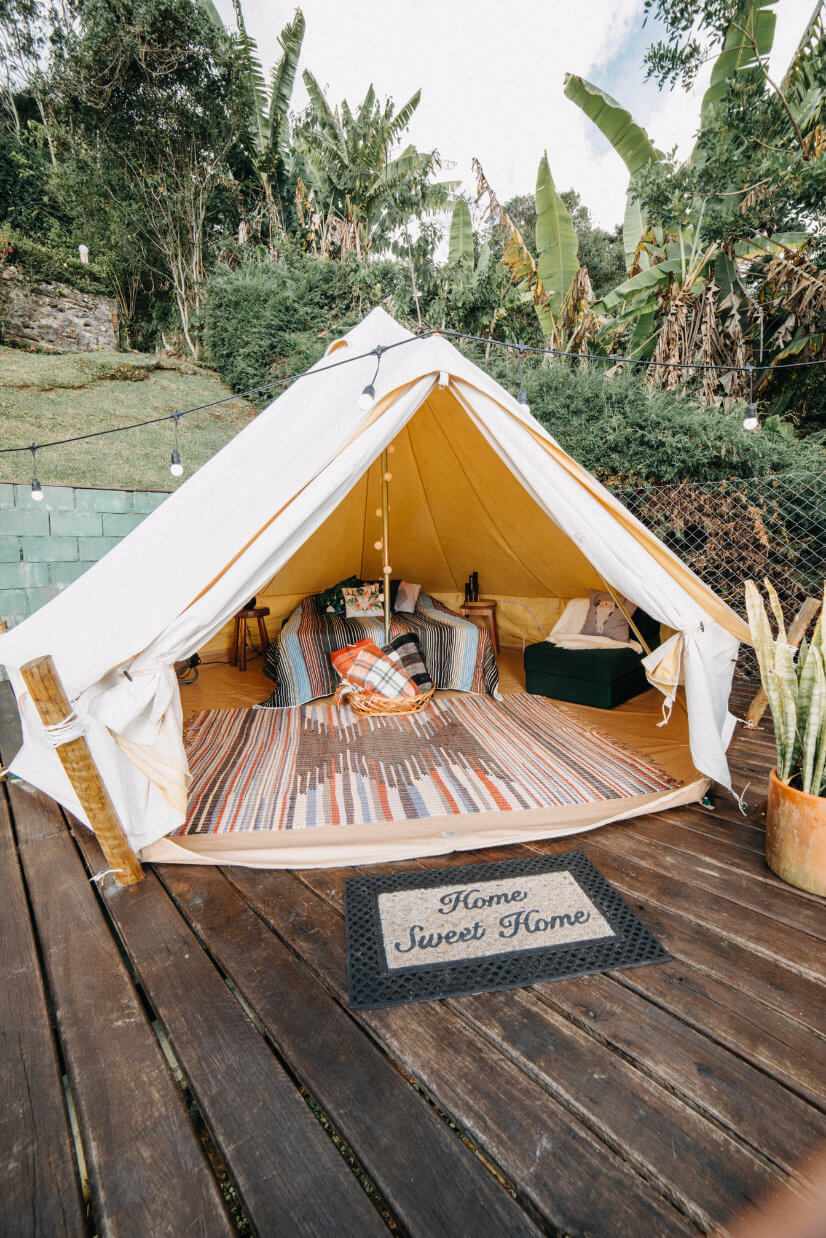
| Tents (glamping) | Efficiency, simplicity of legalization | Seasonality, wear | Beaches, forests, "weekend" locations |
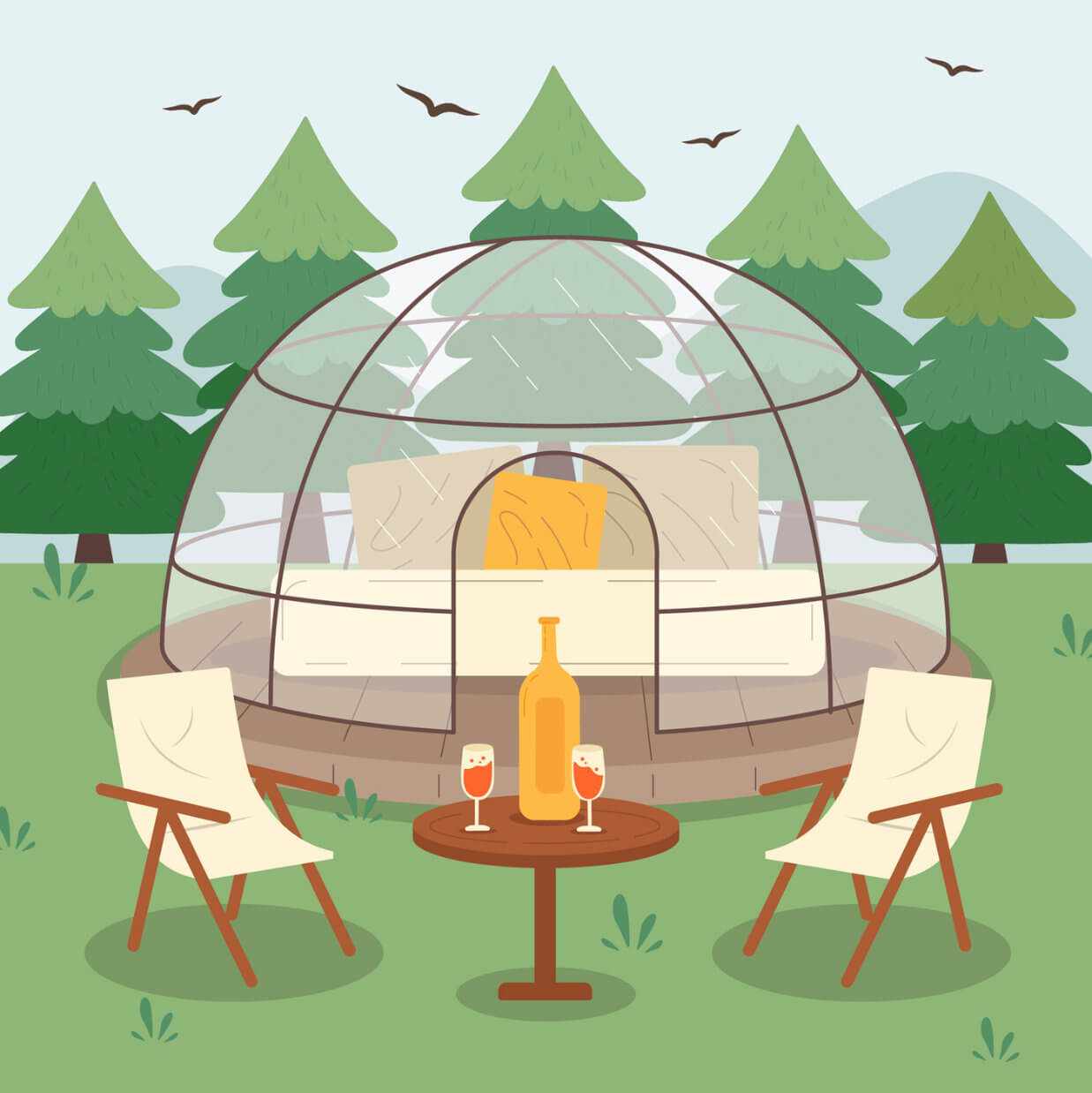
| Dome structures | Energy efficiency, uniqueness | Hard to maintain, unusual format | Eco-concepts, wow projects |
1.3. Architectural code: how a project should respond to landscape
Main principle: architecture doesn't just fit into nature — it enhances it. When designing, consider:
- Relief: build along the slope line, not against it.
- Orientation: south — light, north — wind protection.
- Materials: preference for wood, stone, local resources.
- Fire safety: distance from forest zones, firebreak system.
- View corridors: panorama is the project's asset, it cannot be blocked.
1.4. What an architectural concept should contain at start
- Master plan - Object placement, access roads, utilities
- Units - Type, area, engineering load, construction standards
- Common area - Toilets, kitchen, SPA, reception
- Materials - Specification and origin, cost, logistics
- Scaling options - Possibility of installing additional units
- Impact on CAPEX - Calculation per unit, with finishing, engineering
Questions for reinforcement:
- How does architecture affect the project's financial model?
- Why is glamping not always cheaper than a modular house?
- What does "architecture enhances landscape" mean?
- What architecture mistakes affect OPEX?
- What elements would you include in an architectural specification?

2. Bioclimatic analysis and sustainability — a project that works with nature, not against it
Goal: Teach participants to consider climatic, landscape and resource conditions when designing, to ensure energy efficiency, functionality and sustainability of hotel infrastructure.
2.1. Why climate is not "weather", but an economic variable
Many projects fail because:
- They underestimated seasonality
- They didn't account for seismicity
- They incorrectly calculated insulation and ventilation
- They chose materials unsuitable for altitude or humidity.
Result — increased OPEX, tourist refusals, constant breakdowns.
Professional approach: bioclimatic analysis
This is a systematic assessment of location by 5 parameters:
- Temperature: seasonal fluctuations, amplitude
- Precipitation: rain, snow, humidity
- Wind: wind rose, direction, strength
- Insolation: sun, shade, orientation
- Relief: slope, accessibility, erosion
2.2. Sustainability concept: what "sustainable hospitality" means
Sustainability is not only about "green technologies", but also about reducing costs, risks and dependence on networks.
Sustainability components:
- Autonomy: water, energy, waste disposal
- Ecology: minimal intervention in landscape
- Materials: durable, adapted to climate
- Building life cycle: maintainability, reuse
2.3. Tools: how to do a proper bioclimatic analysis
- Weather data for location — minimum 5 years.
- Topographic survey + elevation profile.
- Wind rose (can be ordered from engineering companies).
- Solstice and shadows: SunCalc program.
- Local engineering conclusions for similar projects.
2.4. How to turn climate into a competitive advantage
- Winter? Add a sauna, hammam, cabins with fireplace.
- Heat? Use shaded zones, dense materials, external blinds.
- Wind? Offer "wind salons", zones with fireplaces and panorama.
Nature is not an enemy, but content. The question is how you package it.
Reinforcement: test yourself
- What is bioclimatic analysis and why is it needed?
- How does wind affect structure and comfort?
- What tools help calculate sun and shade on a site?
- What does "sustainability" mean in the context of glamping?
- What 3 climatic features of Armenia need to be considered when designing?
3. Modularity, scaling and phased implementation — growth strategy without overload
Goal: Teach participants the principles of step-by-step design and scalability: how to create a system that grows with the market and doesn't require capital "all at once".
3.1. Why modular approach is not "just about construction", but about strategy
Modularity in development is the ability of a project to be:
- broken into phases (phaseable)
- easily scalable (without destroying previous blocks)
- flexible in operation (format changes, unit replacement)
- manageable at the level of costs and team.
Question at start: are you building a business or a static structure?
- Bad: "We'll build 12 cabins at once — and see."
- Good: "We'll build 5, test occupancy, scale to 12 based on demand."
3.2. Launch phasing: 3 phases
| Phase | Goal | Composition | Cost control |
|---|---|---|---|
| Phase 1: MVP | Model validation | 3-5 units + toilet + basic reception | Up to 30% of total CAPEX |
| Phase 2: Optimization | Expansion with confirmed demand | +5-7 units, kitchen, additional amenities | Next 40% CAPEX |
| Phase 3: Strengthening | Commercialization, reinvestment | Final infrastructure: SPA, event zones | 30% and refinancing |
3.3. How to design with scalability in mind
Architectural principles:
- Site is designed not as "12 cabins", but as "cluster with N zones".
- Utilities — linear or ring (not radial).
- Common zones — in center or at start of site, to serve different phases.
- Units — self-sufficient, can be replaced/moved.
- Foundations — unified (one type for all modules).
Example: Glamping was designed with 4 units, but at project level had layout for 16. After a successful season, it was easy to add 8 more, because water, sewerage, electricity were pre-installed with reserve.
3.4. Scaling without losing quality
- Project is initially created as a "scalable platform", not a "unique object".
- Elements are standardized: structure, furniture, decor, equipment.
- Brand and operational matrix are formed, suitable for franchising.
- Growth stages are written into business plan and architectural documentation.
Example architectural note: "The project provides for phased placement of units in 3 stages of 4 modules each using existing utilities. Technical capacity is provided for 150% load from Phase 1."
3.5. Mistakes without phasing
| Mistake | Consequences |
|---|---|
| Built everything at once, without demand | Under-occupancy, high depreciation |
| No utilities with reserve | Connection cost ×2 when expanding |
| Zones not designed for growth | Service zones overloaded |
| One project — one format | Cannot segment, lose flexibility |
| No weather adaptability | Seasonal limitation, inconveniences |
Reinforcement: test yourself
- What is modularity in hotel architecture?
- How should utilities be arranged in phased construction?
- What does "architecture as scaling platform" mean?
- Why include "redundant capacity" in a project?
- How to grow a project without redesign?
4. Materials, engineering nodes and standards — how to build so you don't have to rebuild
Goal: Provide understanding of which materials and structures are suitable for different conditions in Armenia, how to avoid mistakes, what "engineering nodes" are and which standards ensure reliability.
4.1. Why "cheaper" doesn't mean "cheap"
Key mistake: choosing cheap materials without considering operation.
Result:
- mold after 6 months
- heat loss in winter
- structure deformation
- system failures in peak seasons
4.2. Material selection: climate + operation + service
- Frame: Glued laminated timber, galvanized metal. (Avoid: raw lumber).
- Cladding: Moisture-resistant plywood, fiber cement, thermo-pine. (Avoid: OSB without impregnation).
- Roof: Metal, PVC membrane, flexible shingles. (Avoid: flat roofs without insulation).
- Floors: Laminated plywood, decking. (Avoid: linoleum, particleboard).
4.3. Engineering nodes: weak points
An engineering node is a connection of elements where heat, moisture, and load leaks are possible. For example: roof-to-wall connection, building corners, sewer connection to unit.
- Each node must be described in architectural documentation.
- Drawings with details of fasteners, protection, insulation are needed.
- Work "by eye" — path to accidents and cost overruns.
4.4. Certification and standards: what investors and insurance check
- Safety - Fire treatment of wood, ventilation, emergency access.
- Sanitation - Compliance with norms for water supply, septic tanks, waste.
- Electrical - Certified panel, insulation, grounding.
- Construction - Seismic resistance, durability, compliance with building codes.
4.5. How to avoid rework: 5 rules of reliable design
- Materials are chosen at specification stage — not during construction.
- Each utility point (water, electricity, sewerage) is fixed in plan.
- Suppliers participate in design.
- Operations engineer — from day one of project.
- Any "non-standard element" is accompanied by node drawing.
5. From architectural concept to technical specification: packaging the project into documents
Goal: Teach how to translate an idea and concept into architectural and engineering documentation that can be used to build, invest and protect parties' interests. Show what documents a contractor should receive — and how to avoid "amateur work" on site.
5.1. Problem: beautiful idea ≠ working documentation
In practice, 70% of projects in the glamping segment face the same thing:
- Architect makes a "picture", but doesn't draw nodes.
- No specification — builders "assemble from what's available".
- Estimate is outdated or based on incorrect volumes.
- Contractor starts work before fixing deadlines, conditions, quality.
Result: cost overrun, conflicts, poor quality, no warranty.
5.2. Documentation structure: from concept to construction site
| № | Document | What's in it |
|---|---|---|
| 1 | Architectural concept | 3–5 visualizations, master plan, zoning. What, where, how will be placed |
| 2 | Architectural assignment (AR) | Unit drawings, nodes, orientation, materials. Basic package for understanding architecture |
| 3 | Engineering assignment (IOS) | Electrical, water, sewerage, ventilation. Network routing, panel placement |
| 4 | Estimate | By items, suppliers, with VAT. CAPEX with details, "no surprises" |
| 5 | Construction schedule | Gantt chart, deadlines, dependencies. What, when, who is responsible |
| 6 | Contractor specification | Checklist, standards, control points. What the contract and quality control are based on |
5.3. Documents investors check before payment
- Building permit / letter that permit is not needed.
- AR and IOS project.
- Estimate confirmation: three quotes from suppliers.
- Work schedule and payment stages.
- Control system: technical supervision/auditor.
5.4. How to control construction without daily presence
- Photo documentation and reports every 3–5 days.
- Video calls at key stages.
- Delivery control: acts, warehouse.
- Construction log — date, what was done, deviations.
- Progress by Gantt — report by % completion.
Module 2 Conclusion. Now we know:
- How architecture affects economics, sustainability and scalability.
- How to properly design units and choose materials.
- What's needed for legal, energy-efficient, scalable infrastructure.
- How to package everything into documents that work.
MODULE 3. FINANCING, INVESTMENTS AND PROJECT ECONOMICS
1. How to calculate: CAPEX, OPEX and revenue structure
Page goal: Teach participants to create a real, verifiable financial model for small accommodation formats, account for all expenses and form revenue forecasts in different scenarios.
1.1. Economics starts before construction
Common mistake — calculate the model "later": when land is already bought, work started or materials received.
Correct: financial model is a tool before investment. It:
- shows project feasibility,
- determines needed capital volume,
- helps compare solutions,
- protects you before partners, banks, grant providers.
1.2. Model structure: 3 blocks
- CAPEX (Capital Expenditures) - All startup costs: land, utilities, construction, equipment, brand.
- OPEX (Operating Expenses) - Annual expenses: salaries, utilities, repairs, marketing.
- Revenue - Nights × rate × seasonality + additional services (meals, events).
1.3. CAPEX breakdown
| Item | Range (% of CAPEX) | Commentary |
|---|---|---|
| Land / lease | 10-25% | Purchase or prepayment for 10-15 years |
| Architecture / project | 5-8% | Visualizations, AR, IOS, author supervision |
| Engineering | 20-30% | Water, electricity, septic, panels, boilers |
| Unit construction | 25-40% | Cabins, tents, foundations |
| Common areas | 10-20% | Toilets, kitchen, reception |
| Furniture, equipment | 10-15% | Appliances, bedding, decor |
| Reserves | 5-10% | For unforeseen expenses |
Insight: On average, CAPEX for an 8–10 unit project in Armenia — from $130,000 to $250,000.
1.4. OPEX: operating expenses — what payback depends on
- Staff: Administrator, cleaning. (1–3 people).
- Utilities: Electricity, water, gas. (Higher with autonomy).
- Maintenance: Minor repairs (3–5% of CAPEX per year).
- Marketing: Booking, SMM (8–12% of revenue).
- Licenses / insurance: Especially important when leasing land.
1.5. Revenue: how to forecast revenue correctly
Basic formula:
ADR (Average Daily Rate) × Occupancy × Number of units × Days per year
Add:
- Seasonality — occupancy by months,
- Scenarios — Base, Best, Worst,
- Additional services — meals, rentals, events.
Example:
- 10 units
- ADR = $60
- Average occupancy = 42%
- Year: 365 days
Revenue (main): $60 × 0.42 × 10 × 365 = $91,980
Additional revenue: ~15% = $13,797
Total: ~$105,000 per year
Reinforcement: test yourself
- What's included in CAPEX and why is architecture not "design"?
- What expense items in OPEX "hide" in seasonality?
- How does ADR differ from RevPAR?
- What revenue sources besides nights are possible in glamping?
- What model element is responsible for sustainability in a "bad year"?
2. Scenario planning, payback, IRR and risk management
Goal: Teach participants to use financial project analysis tools, calculate payback period, IRR, build "best / base / worst" scenarios and see how risks are reflected in object economics.
2.1. Why one model is a trap
Many developers build one model with optimistic numbers. In reality, everything goes according to a different scenario. Project financial sustainability is determined not by an "ideal" table, but by its ability to withstand deviations:
- in occupancy,
- in rate,
- in expenses.
Investor wants to see:
- How quickly the project goes positive.
- What happens in a "bad year".
- Is there an anti-crisis model.
2.2. Payback Period: payback period
Formula:
CAPEX / EBITDA (net operating profit) = period in years
Example:
- CAPEX: $160,000
- EBITDA: $50,000
- → Payback = 3.2 years
Important: land cost is not included in calculation (if it's not part of the project).
2.3. IRR (Internal Rate of Return)
IRR is the percentage at which discounted value of future cash flows = investments. The higher the IRR — the more attractive the project.
| IRR | Interpretation |
|---|---|
| < 10% | Weak investment attractiveness |
| 10–15% | Moderate (close to bank risks) |
| 16–25% | Good for tourism |
| > 25% | Excellent, requires verification |
2.4. Risk management through scenarios
How a professional acts:
- Uses Worst-case scenario as basis for reserve calculation.
- Has "economy mode" in OPEX.
- Signs flexible contracts (advertising, phase 2).
- Insures key risks (fire, season cancellation).
Example "anti-crisis plan" for project:
- Scenario: occupancy dropped 30% (force majeure).
- Measures:
- Automate guest reception (remove administrator).
- Close 50% of units in weak months.
- Redirect marketing to local market.
- Refinancing: restructure debt with deferred schedule.
3. How to prepare a project for investment — from one-pager to investment memorandum
Goal: Teach participants to properly format investment documents to professionally present a project, not lose trust and simplify negotiations with investors, funds, banks or government structures.
3.1. What is "investment readiness"
This is not just having an idea. It is:
- Structured project,
- Worked out economics,
- Legally clear object,
- Documents that speak investor language.
3.2. One-Pager structure: 1 page, but with precise targeting
What should be:
- Project name and tagline.
- Geography and map.
- Format: number of units, features.
- Financial indicators: CAPEX, OPEX, RevPAR, EBITDA, IRR.
- Investment need.
- Exit Strategy (what investor gets and when).
- Contact and link to presentation.
Example:
- GLAMPSYUNIK — "LIVE AT THE EDGE OF THE SKY"
- 10 MODULES AT 1800 M ALTITUDE, SAUNA, GASTRO ZONE
- LOCATION: SYUNIK, GPS + MAP
- CAPEX: $170,000 / EBITDA: $48,000 / IRR: 22.4%
- INVESTMENT NEEDED: $130,000 FOR 45%
- EXIT: IN 3 YEARS, BUYBACK / DIVIDENDS
3.3. Pitch Deck — presentation structure
- Problem: format deficit, market without standard.
- Solution: our format, design, service.
- Product: how the campsite works.
- Market: who, how many, how often.
- Model: ADR, occupancy, profit.
- Team and Exit Strategy.
Important: 10–15 pages, minimum text.
3.4. Investment Memorandum (IM) — for due diligence and funds
This is the main investment document: needed for large investors, banks, funds.
What it includes:
- Executive Summary (summary)
- Geography, land, rights
- Architecture and engineering
- Financial model
- Team
- Competitors
- Risks and scenarios
- Legal structure
- Exit Strategy
- Appendices: cadastre, project, calculations, licenses
Volume: 20–30 pages
Language: formal but readable, like McKinsey
CASE: How not to lose investor trust
A project in Gegharkunik tried to attract $90,000. Presentation — 35 slides of text, no calculations, no model, no deadlines. Investor refused, saying: "If they can't present, how will they manage?"
CONCLUSION: Investors judge by document, as by a manager.
4. Where to find investments — private capital, grants, banks and partners
Page goal: Show participants all real channels for financing hotel infrastructure projects in Armenia, their features, pros and cons, documents that will be required, and strategies for interaction with investors and institutions.
4.1. 4 key sources of capital
| Source | Pros | Cons | When to use |
|---|---|---|---|
| Private investors / angels | Flexibility, quick decision | Require equity, personal contact | Startups, pilot objects |
| Funds and accelerators | Transparent terms, growth | Require maturity, reporting | Scaling, network |
| Grants | Non-refundable | Application complexity, deadlines | Sustainability, social effects |
| Banks | Predictable | Collateral, interest | For equipment purchase, phase 2–3 |
Example structure:
Project: private investor ($110,000) + grant from EU4Business ($25,000) + equipment loan ($15,000).
4.2. Private investors: how to approach and what to say
They care about:
- Legal cleanliness of project,
- Specifics and numbers,
- Control and share protection,
- Exit strategy: how and when they'll get money back.
Documents for private investor:
- One-Pager + Pitch Deck,
- SHA (shareholders agreement),
- Receipt or loan agreement (if not through SPV),
- Investment protocols (signatures, accounts, confirmations).
4.3. Grants: how they work and what they require
What grant providers look at:
- Sustainability: ecology, local development,
- Social effect: jobs, community development,
- Standards and reporting: you must "run the project" correctly.
Examples of active programs:
- EU4Business (EU): sustainable tourism, digitalization,
- GIZ (Germany): green solutions, women in business,
- UNDP / SDG Fund: sustainability, ESG, biodiversity.
Document package:
- Legal entity registration,
- Project + financial model,
- Social justification,
- Schedule and KPIs,
- Letter of support from local self-government (optional).
4.4. How "not to scare away" investor or grant provider
- Be honest: write risks, don't understate CAPEX.
- Speak their language: structure, % equity, reporting, standards.
- Don't pressure — show: models, real cases, growth plans.
- Be ready for due diligence.
Case:
A team lost a GIZ grant because in the application they indicated "approximate" estimates and couldn't confirm land designation. Grant was rejected at final stage.
Conclusion: even small carelessness = failure of entire campaign.
Reinforcement: test yourself
- What are pros and cons of each capital source?
- What is SHA and why is it needed?
- What documents do funds and grant providers require?
- Why can't you understate CAPEX in application?
- What tools are suitable for phase 2 (expansion, equipment)?
5. Financial sustainability, deal structure and investment protection
Page goal: Teach participants to properly structure investment deals, protect capital, form a sustainable model with transparent jurisdiction, financial control and legal guarantees.
5.1. What "sustainability" means in an investment deal
Sustainability =
- Transparent equity structure
- Clear understanding of who is responsible for what
- Ability to exit without losses
- Presence of legal and operational protection
Investors fear:
- "Disappearance" of team
- Share dilution
- Unmanageable risks
- Absence of exit path
5.2. Legal structure of investment
Ideal form — SPV (LLC), where:
- Land and object belong to company, not individual,
- Shares are fixed, investments formalized in charter capital or through loans,
- Decisions made according to charter and SHA (Shareholders Agreement).
5.3. How to structure investment: 3 formats
| Format | Application | Tools |
|---|---|---|
| Direct equity | Strategic partner | Share in SPV, SHA, dividends |
| Loan with interest | Conservative investor | Loan agreement + repayment schedule |
| Equity + buyback | Wants to invest and exit | Share + buyback agreement by formula |
Important: any format must be formalized in writing, with party registration, signatures and confirmation of investment amount (payment / receipt / act).
5.4. Control and capital protection: tools
| Tool | What it does |
|---|---|
| SHA (shareholders agreement) | Fixes rights and obligations, prohibition on actions without consent |
| Escrow | Money held by notary / legal entity until conditions are met |
| Options | Right to buy/sell share under certain conditions |
| Risk insurance | Fire, launch delay, death of key figure |
| Beneficial agreement | Shows who is real owner, especially for investments through third countries |
5.5. Financial monitoring and execution control
- Reports on expenses and revenue — minimum monthly.
- Access to bank statements / accounting / CRM — by agreement.
- Budget approval — by SHA.
- Restrictions on expenses > X $ — only with consent of all participants.
- Internal auditor or accountant — for projects from $200,000.
CASE: A project in Gegharkunik received $150,000 from a private investor. There was no SHA. After 6 months, the team increased charter capital and diluted investor share to 18%. Court started, object frozen.
CONCLUSION: Contracts protect capital. And only contracts.
The course was prepared by the Easy Life Consulting Group team as a working tool for decision-makers: investors, developers, architects and hotel business managers.


